How to Read a Birth Chart: A Step-by-Step Guide for Beginners
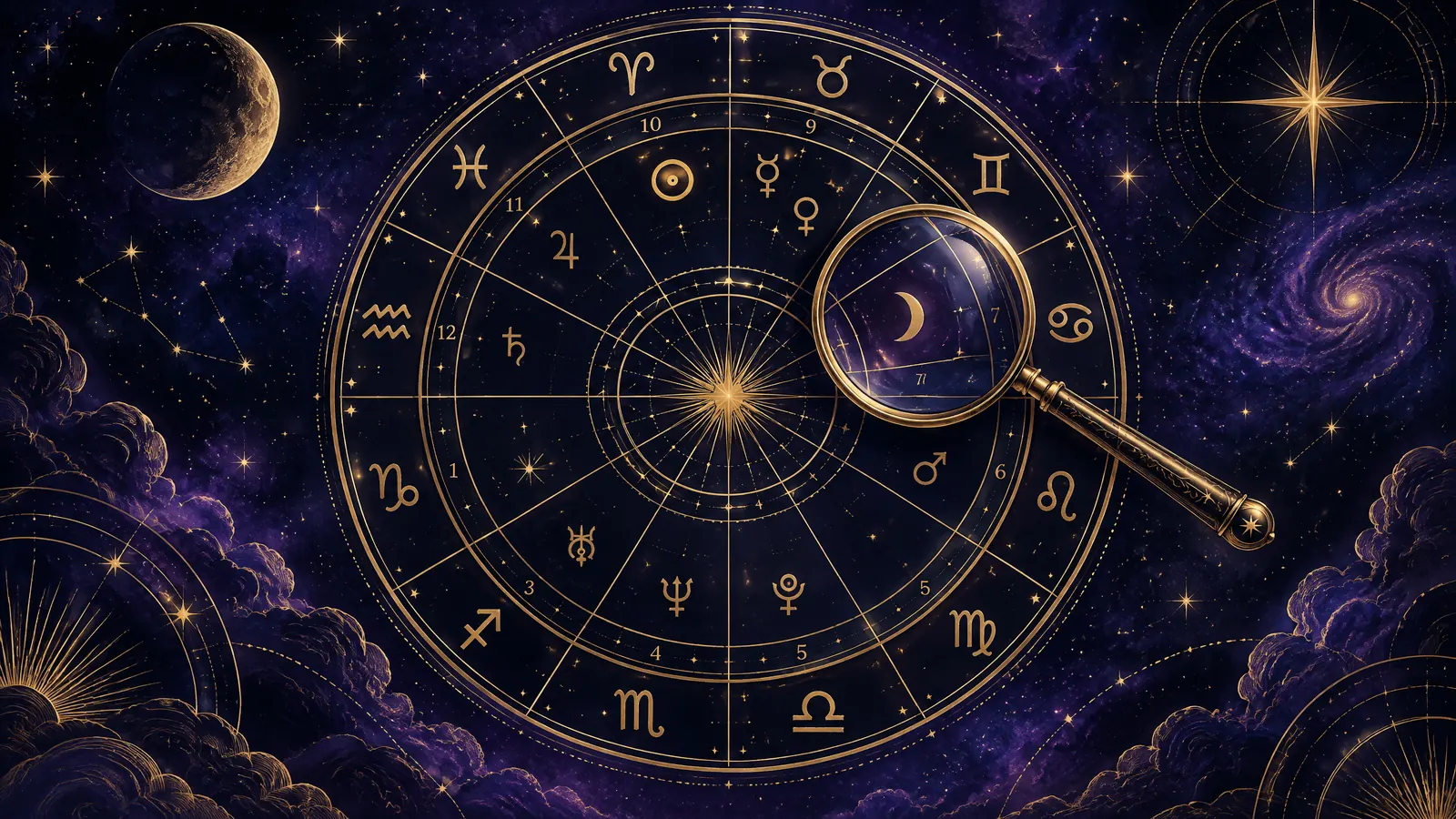
To read a birth chart, look at four layers in order: the planets (what kind of energy), the signs (how that energy is expressed), the houses (where in life it shows up), and the aspects (how the planets talk to each other). Start with the Sun, Moon and rising sign, then add one layer at a time.
What is a birth chart?
A birth chart, also called a natal chart, is a map of the sky at the exact moment and place you were born. It shows where the Sun, Moon and planets were along the zodiac, and how they were placed relative to your local horizon.
The chart is drawn as a wheel. The outer ring holds the twelve zodiac signs, the inner sections are the twelve houses, and the lines across the middle are aspects. In Western astrology this is a symbolic, interpretive tradition with a long history, not a scientific measurement of personality. Read it as a language for reflection.
The planets: what each one represents
The planets are the actors in the chart. Each one stands for a basic human need or function. Astrologers include the Sun and Moon, which they call "luminaries," alongside the planets, and still use Pluto even though astronomers reclassified it as a dwarf planet in 2006.
- Sun: identity, vitality, purpose.
- Moon: emotions, needs, instinct, home.
- Mercury: thinking, speech, learning.
- Venus: love, values, beauty, what you enjoy.
- Mars: drive, courage, anger, desire.
- Jupiter: growth, faith, generosity, opportunity.
- Saturn: structure, responsibility, limits, maturity.
- Uranus: change, independence, the unexpected.
- Neptune: imagination, spirituality, ideals, confusion.
- Pluto: power, depth, endings and renewal.
The Sun through Mars are the "personal" planets and describe you most directly. Jupiter and Saturn connect you to society. Uranus, Neptune and Pluto move so slowly that whole generations share their signs, so their house placement matters more than their sign.
The signs: how the energy is expressed
The sign a planet occupies describes its style. Mars in Aries acts quickly and openly; Mars in Cancer acts protectively and often indirectly. The planet is the same need, but the sign changes the way it is met.
Each sign belongs to an element (fire, earth, air or water) and a modality (cardinal, fixed or mutable). If you are new to the signs, our guide to the Sun, Moon and rising signs includes a full table of all twelve with their elements and modalities.
The 12 houses: where life happens
The houses divide the chart into twelve areas of life. The first house begins at the ascendant, the eastern horizon at your birth, and the houses then run counterclockwise around the wheel. Because they depend on the horizon, the houses require an accurate birth time and place; if you lack a time, see reading a chart without a birth time.
| House | Life area | Natural sign |
|---|---|---|
| 1st | Self, body, appearance, first impressions | Aries |
| 2nd | Money, possessions, values, self-worth | Taurus |
| 3rd | Communication, siblings, neighbors, everyday learning | Gemini |
| 4th | Home, family, roots, private life | Cancer |
| 5th | Creativity, romance, children, play | Leo |
| 6th | Daily work, routines, service, habits of care | Virgo |
| 7th | Marriage, partnerships, open agreements | Libra |
| 8th | Shared resources, intimacy, inheritance, transformation | Scorpio |
| 9th | Beliefs, higher learning, travel, philosophy | Sagittarius |
| 10th | Career, vocation, reputation, public role | Capricorn |
| 11th | Friends, groups, community, hopes | Aquarius |
| 12th | Solitude, spirituality, the hidden and the unconscious | Pisces |
A planet in a house brings its energy into that area. Venus in the 10th house, for example, often points to work involving beauty, diplomacy or people, or to being liked in public life. An empty house is normal and does not mean that area is missing; look at the sign on its cusp and that sign's ruling planet instead.
There are several house systems, such as Placidus, Whole Sign and Equal. They can place a planet in different houses, so do not be alarmed if two websites disagree. Pick one system and stay consistent.
Aspects: how the planets interact
Aspects are specific angles between planets, measured in degrees around the 360-degree wheel. They show which parts of you work together easily and which create tension that pushes you to grow.
| Aspect | Angle | Symbol meaning | Typical feel |
|---|---|---|---|
| Conjunction | 0° | Planets fused together | Intense, blended, focused |
| Sextile | 60° | Friendly opportunity | Easy cooperation that needs effort to use |
| Square | 90° | Inner friction | Challenge, drive, growth through effort |
| Trine | 120° | Natural flow | Talent, ease, sometimes complacency |
| Opposition | 180° | Two ends of a seesaw | Balance, projection onto others, awareness |
Aspects are allowed a margin called an orb, often up to about 6 to 8 degrees for major aspects involving the Sun or Moon and a little less for other planets. Astrologers differ on exact orbs. The tighter the angle, the stronger the aspect is usually read. For an overview of the tradition, the Wikipedia article on astrological aspects is a neutral starting point.
"Hard" aspects (squares and oppositions) are not bad. Many astrologers find them the most motivating parts of a chart, while "soft" aspects (trines and sextiles) describe gifts that can be taken for granted.
A step-by-step order for reading your chart
Read in layers, from the most personal to the most detailed. This order keeps you from drowning in symbols.
- The big three. Note your Sun, Moon and rising sign, and read them as one sentence about who you are, what you need and how you show up.
- The chart ruler. Find the planet that rules your rising sign (for example Mars for Aries rising, Saturn for Capricorn rising) and see which sign and house it is in. It often describes the main theme of your life.
- Element and modality balance. Count which elements and modalities hold the most planets. A chart with no earth, for instance, may describe someone who has to work consciously at practical routines.
- Personal planets. Read Mercury, Venus and Mars by sign and house: how you think, love and act.
- Houses with several planets. A cluster of three or more planets in one house (a stellium) shows an area of life that carries extra weight.
- Tight aspects. List the aspects with the smallest orbs, especially those touching the Sun, Moon or chart ruler. These are your strongest internal dialogues.
- Jupiter, Saturn and the outer planets. Read them mainly by house and by their aspects to personal planets.
- The overall story. Step back and look for themes that repeat. If three different factors point to independence, independence is a real theme for you.
Reading your chart alongside other traditions
A birth chart becomes richer when you compare it with other systems. Estrella calculates planetary positions from astronomical data for your exact moment and place of birth, then reads them together with Pythagorean numerology, Kabbalah and gematria, Human Design and Gene Keys, looking for themes that repeat across traditions. You can create your free soul map to see your own chart explained in plain language.
A chart describes tendencies and potentials, not fixed outcomes, and it is meant for self-reflection rather than professional, medical or financial advice. If you want to learn how charts compare between two people, read our guide to astrology compatibility and synastry.
When you are ready, start your free first reading on the site in a few short questions. The full soul map, more than 20 pages on love, work, family, personal growth, the year ahead and the numbers of your name, is delivered as a PDF on WhatsApp.
FAQ
What should I look at first in my birth chart?
Start with your Sun, Moon and rising sign. Together they give the clearest summary of the chart. Then look at the planet that rules your rising sign, because it often points to your central life theme.
What does an empty house mean in a birth chart?
Nothing is missing. With ten planets and twelve houses, some houses are always empty. Look at the sign on that house's cusp and where its ruling planet sits to understand how that area of life works for you.
Why do different websites show my planets in different houses?
They are probably using different house systems, such as Placidus or Whole Sign, or a slightly different birth time. The signs of the planets will match; only the house boundaries move. Choose one system and use it consistently.
Are squares and oppositions bad aspects?
No. They describe tension, and tension produces effort and growth. Many astrologers consider hard aspects the source of a person's drive, while trines and sextiles describe natural gifts.
Keep reading
Sun, Moon and Rising Meaning: A Clear Guide to Your Big Three in Astrology
Learn what your Sun, Moon and rising signs mean, why the rising sign needs your birth time and place, and how the big three work together.
Astrology Compatibility and Synastry Explained: How Two Birth Charts Meet
Learn how synastry and composite charts compare two people, which planet contacts astrologers check, and why Sun signs alone say little about love.
What Is a Soul Map? A Plain-English Guide to Soul Map Readings
Learn what a soul map is, which five traditions it draws on, and what a soul map reading covers. Start with a free first reading in a few questions.
For self-reflection and personal growth only: not a prediction, a promise or professional advice. Maps and texts are created with AI.